1. Observe
Capture concise location-based updates.
Sanctuary Signal helps church security teams message individuals, roles, or everyone on duty from phones volunteers already carry. See product tour or read the product overview.
Coordinate ingress, egress, and perimeter events with focused routing.
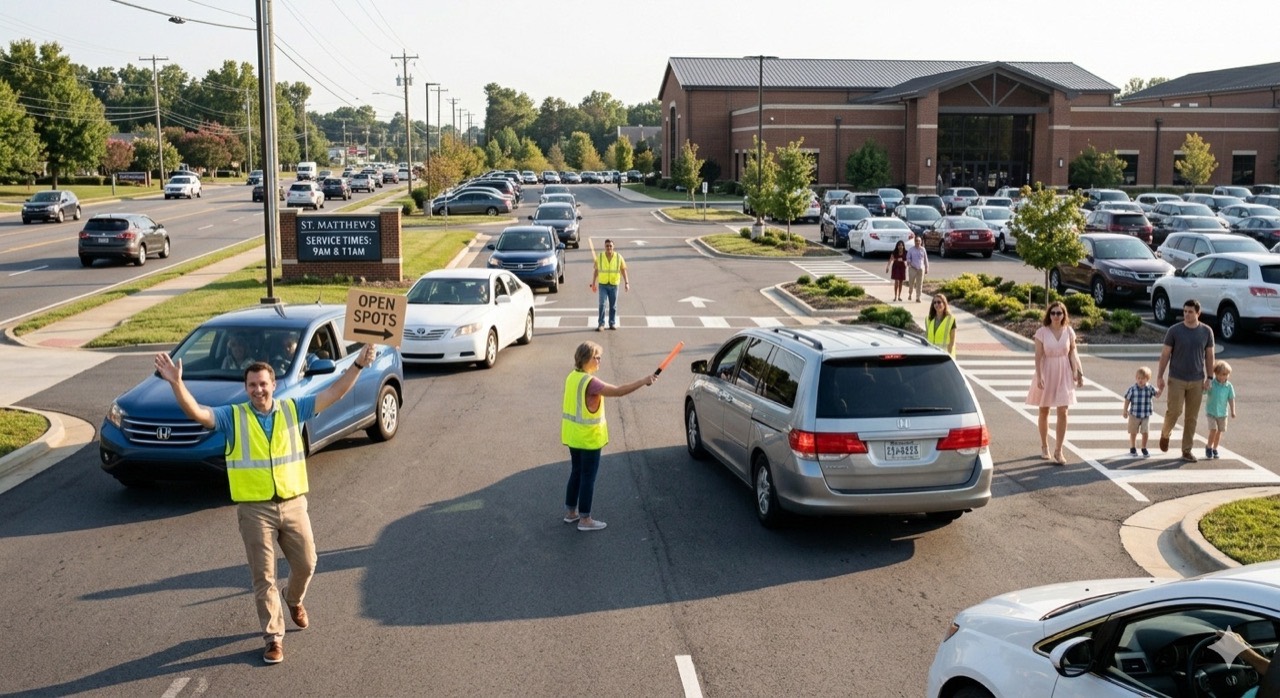
Parking and perimeter situations move quickly. The communication pattern should stay clear: observe, escalate to the right people, then resolve with documented closure.
Capture concise location-based updates.
Route to supervisor and nearest on-duty responders only.
Confirm closure and preserve context for review.
Parking teams often need fast, practical updates that are not full emergencies: three spaces left in the lower lot, start sending cars to the upper lot, or hold traffic for a pedestrian crossing. Sanctuary Signal gives parking volunteers a quiet SMS-based channel for routine coordination when radios are unreliable, too public, or unable to reach across a large campus.
Routine lot SMS: Short status lines like LOWER LOT: 3 spaces left. Start routing new arrivals to UPPER LOT. stay in the parking
channel without paging the whole team.
This is routine operations, not the same playbook as medical or suspicious-person escalation below. When posture changes, follow the escalation sequence and supervisor routing your team has defined.
Perimeter events rarely fail because nobody cares. They fail because too many people care out loud at once: duplicate observations, conflicting instructions, or well-meaning volunteers stepping into a situation without a clear assignment. The sequence above is intentionally short so it can be rehearsed. In real life, add named roles for who owns the radio channel (if any), who speaks with law enforcement if they arrive, and who updates children’s ministry or the auditorium team if traffic flow changes.
Document two or three standard phrases your team will actually use (“west lot clear,” “requesting director,” “medical assist inbound”) and practice them when it is calm. If you pair SMS discipline with occasional radio use, decide in advance which channel carries narrative detail and which carries commands. For adjacent scenarios, read suspicious person BOLO and medical incident flow so parking volunteers know how their updates plug into wider coordination.
Escalation SMS demo: Parking coordination on operational templates (blocked fire
lane, owner contact, then @LEO).