Church radios vs PoC/LTE radios vs SMS
Radios are immediate. PoC devices feel modern. Structured SMS stays quiet and accountable.
Security teams can benefit from more than one channel - but marketing claims about cellular radios, UHF/VHF failover, and emergency resilience need a Sunday-reality check. Sanctuary Signal helps you keep voice where it belongs and add discreet, duty-aware texting without another group thread.
Where traditional radios help
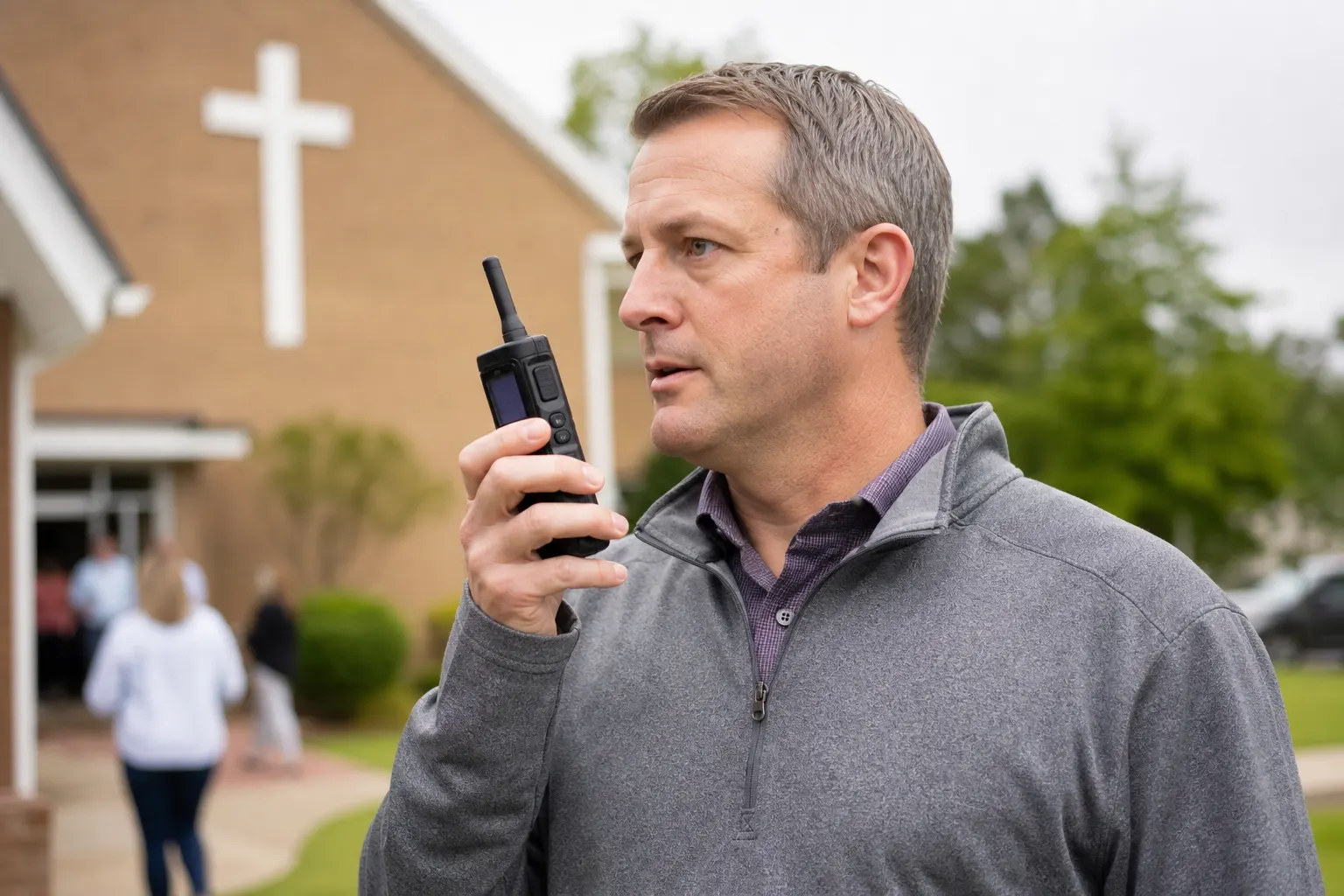
Immediate voice coordination across active responders. Parking, perimeter, and building sweeps often benefit from short, trained voice traffic when describing movement is faster than typing.
PoC / LTE radios (PoClink and similar)
Push-to-talk over cellular (PoC) and LTE radio brands are pushing hard on social media. The pitch is familiar: wide-area coverage, smartphone-like features, and a backup radio path for rural or emergency use. For church security leaders, the useful question is not "is the ad impressive?" It is "what still works when coverage is thin, towers are saturated, or worship needs quiet?"
What they actually ride on
Most PoC/LTE radios lean on cellular towers for their primary talk path. That can feel excellent when your carrier is strong across campus and parking. It is still a network product, not an island of RF that magically ignores congestion, outages, or carrier gaps between buildings.
UHF / VHF / GMRS failover is not encrypted privacy
Some devices advertise UHF or VHF failover (often in the same conversation as GMRS-style consumer frequencies). That local RF path can help nearby responders talk when data drops - and that can be valuable. It is also typically not encrypted the way a cellular data session may be. Treat failover audio as potentially overheard by anyone with a scanner or nearby radio on the same channel family. "Minimally safe to use" for security does not mean "private operational channel."
Two PTT buttons is a major volunteer failure mode
Many PoC/LTE radios with UHF or VHF failover put two different push-to-talk buttons on the same handset - one for the cellular PoC path, one for the local RF failover path. That looks like resiliency on a product sheet. On a stressed Sunday, it is a predictable failure point.
Rotating volunteers already carry enough cognitive load. Under urgency they will key the familiar button, the wrong path, or both in confusion. The result can be: talking into a dead cellular path while nearby teammates are on RF, keying RF while leadership expects PoC talk groups, or freezing because the radio "did not work" when they pressed the wrong control. Dual-PTT failover is not free redundancy - it is another mode switch that must be trained, labeled, and drilled, or it will fail when you need it most.
The emergency marketing claim vs real disasters
Ads often highlight rural reach and the idea that when cell service fails you somehow keep going - as if failover to other carrier towers happens cleanly under stress. In a regional emergency, many towers can be damaged, powered down, or saturated by everyone trying to call at once. Local RF may still help people near each other. It does not guarantee multi-carrier recovery across a county.
Western North Carolina saw this during Helene: days of widespread outages driven by power and fiber loss, then more days of limited calls and data even after sites began recovering. Disaster roaming and emergency-call pathways were discussed publicly, but everyday commercial traffic often stayed constrained. Starlink or iPhone SOS were rare lifelines - and abysmally slow. That is not an argument against radios. It is an argument against buying a single vendor story as your whole continuity plan.
Read the full write-up: Hurricane Helene communication lessons for church safety teams - including indoor sanctuary coverage warnings, eSIM redundancy in the field, and why we prefer encrypted UHF plus structured SMS with a clear "hop to radio" rule.
Where PoC/LTE can still fit
- Wide-campus or multi-site voice when cellular coverage is strong and volunteers are trained
- Teams that already standardize on a PoC fleet and need disciplined talk groups outdoors
- A redundant voice option alongside traditional RF - not a replacement for quiet in-sanctuary coordination
Where structured TEXT helps
Discreet routing to the right people, message history, and improved accountability after service.
Sanctuary Signal is more than just texting:
- Routed messages: direct messages to your medical team or LEO members who may augment your volunteer team
- Visual review of active watchlist members, with the ability to inquire with the on-shift Supervisor about possible sightings
- Instantly see who else is on duty, improving coordination and reducing radio traffic and confusion
- Send direct messages to off-duty members when extra help is needed quickly
- Enables better team communication, stronger processes, and greater accountability
Structured SMS and thin connectivity
SMS is a best-effort mobile-network service, but for volunteers it often behaves more predictably than a live voice stream or a data-heavy app when the signal bar is barely there. That matters next to radios and PoC devices too: RF voice is its own animal, while anything that rides Wi-Fi or continuous mobile data shares the same brittle path as consumer apps.
On modern phones, outbound SMS is usually a small handshake with the carrier: you get a clear sent state, a visible failed to send state, and a prompt to retry when the handset could not complete delivery. That is different from push-to-talk over IP, where a "connected" icon can hide micro-dropouts that only show up as garbled audio or messages that never quite sync.
Payloads are tiny compared with sustained VoIP or PTT-over-IP, so they tend to ride out marginal service more often than a voice packet stream that needs continuous bandwidth both directions. Nothing is a magic guarantee in every basement - but teams routinely find that CHECKIN, STATUS, and short directives still move when a voice or data app would not stay up.
SMS can also ride Wi-Fi calling or Wi-Fi-assisted paths when phones are configured for it - useful inside buildings where outdoor towers are weak. Delivery remains best-effort: the phone keeps trying, and you get a clear fail/retry when it cannot complete. That is still a different posture than hoping a PoC session stays up in a known dead zone.
Structured routing on top of SMS (who is on duty, who may broadcast, @Name handoffs) is what turns those small messages into Sunday
discipline instead of another group thread. For push-to-talk and Wi-Fi or data tradeoffs in depth, see
Zello vs structured SMS; for the full product picture, start with
platform overview and the product comparison, or return to
comparison guides.
A practical channel decision lens
- Secure UHF radios - immediate local voice for urgent traffic; prefer business-band / licensed UHF with at least color-code privacy (Motorola-style digital privacy as a baseline), not consumer GMRS/FRS alone
- PoC / LTE radios - wide-area voice when cellular is strong outdoors; treat RF failover as overheard audio, not private ops; treat dual-PTT controls as a training risk, not free redundancy; do not rely on them inside a sanctuary already known for poor coverage
- Structured SMS (Sanctuary Signal TEXT) - quiet in-sanctuary updates, duty state, documented routing, Wi-Fi-assisted paths, and retry-friendly thin connectivity
- Hop to radio when the text is stuck - if the message is urgent and SMS is not coming or going, key the radio. Disruption matters less than communicating clearly
Sanctuary Signal should augment radios, not replace them. The goal is predictable behavior under stress - including when social-media radio ads oversell emergency magic. For Western NC disaster lessons, see Hurricane Helene communication lessons.
Radios, PoC devices, and SMS in the real building
Short answers for leaders comparing traditional radios, PoC/LTE devices, consumer apps, and structured SMS on Sunday.
Are PoC or LTE radios like PoClink better than traditional church radios?
They can feel modern and wide-area when cellular coverage is strong. Traditional RF still keeps local voice without depending on the internet. Neither replaces quiet, duty-aware SMS coordination inside worship.
Is PoC radio UHF or VHF failover encrypted and secure for church security?
When a PoC/LTE device falls back to UHF/VHF or GMRS-style analog voice, that local RF path is generally not encrypted like a cellular data session. Treat failover audio as potentially overheard, not as a private security channel.
Why are two PTT buttons on PoC radios a problem for church volunteers?
Many PoC/LTE radios with UHF failover use separate push-to-talk buttons for cellular and local RF. Under stress, volunteers often key the wrong path, talk into a dead cellular channel, or freeze when the radio seems broken. Dual-PTT failover needs deliberate labeling and drills or it becomes a major failure mode.
Do PoC radios keep working when cell towers fail in an emergency?
Marketing often highlights rural reach and emergency failover. In practice, major disasters can saturate or disable many towers at once. Local RF can still help nearby responders, but it is not magic multi-carrier recovery. Helene showed days of outages and then limited commercial traffic even after partial recovery - details in Hurricane Helene communication lessons.
Why is SMS often more reliable than apps that use mobile data?
SMS is built for small, store-and-forward style messages on the carrier messaging path. Consumer chat, maps, and VoIP need a steadier IP session and more round trips. When the network is congested or the handset is in a weak pocket of the building, that difference shows up first in anything that behaves like continuous data - not always in a single short text.
Does that mean SMS beats handheld radios?
Not automatically. Licensed or business-band radios can still win for instant voice among responders who are trained to keep transmissions short. SMS wins for quiet updates, duty state, and history when you do not want every syllable on an open channel - and it often survives marginal phone service in places where IP voice or group apps struggle.
Is SMS guaranteed to deliver in every dead zone?
No. SMS is best-effort like any network service. The practical claim is narrower: in many real campuses, a short structured text is more likely to complete (with a visible failure you can retry) than a sustained voice or data session when coverage is thin. Always validate with walk tests on your own building and carrier mix.
Helene communication lessons Radios vs Sanctuary Signal product comparison Shorter radios vs SMS resource article See broader category comparison