Noise and overload
Open threads train everyone to ignore pings. When something real happens, the channel is already fatigued.
Church safety communication
Sanctuary Signal lets your team message individuals, roles, or everyone on duty from the phones they already carry - without app installs, noisy group texts, or sharing personal contact lists. SMS keeps coordination quiet when radios would disrupt worship or apps go unread.
Sanctuary Signal is not another mass alert app, church management platform, or security training program. It is structured SMS communication for the people actually serving right now - built for quiet coordination during worship, role-based routing, supervisor-controlled broadcasts, and shift-level accountability without requiring an app install.
No app required. Works on the phones your volunteers already carry.

The fastest way to understand Sanctuary Signal is to see the TEXT product walkthrough. See how a volunteer checks in, how leaders view who is on duty, and how messages route by name or role without creating another group text thread.
No app required.
Safety communication should not turn the sanctuary into a dispatch floor. Sanctuary Signal keeps routine coordination quiet, targeted, and organized so volunteers can respond without distracting worship or pulling the entire team into every message like a traditional group chat.
At the end of each shift, supervisors receive a summary with messages and check-in times for accountability and review. End-of-shift summaries.
The people in your pews came to sing, pray, and hear the Word. Your safety volunteers came to serve. Neither group benefits when coordination defaults to whatever is easiest to set up on Monday afternoon.
Group texts are universal, which is why they spiral. Radios solve distance, but not discretion. Mass-notification tools blast one-way alerts, yet Sunday safety is often a two-way, role-specific conversation. Most products were built for chat. You need disciplined volunteer operations.
Open threads train everyone to ignore pings. When something real happens, the channel is already fatigued.
If you cannot answer “who is on post right now?” in ten seconds, you do not have a roster problem. You have a state problem.
Pastors need calm awareness. Directors need authority and audit trails. Volunteers need clarity, not a second social feed.
Sanctuary Signal is not generic messaging software dressed in church vocabulary. It is duty-aware SMS coordination: CHECKIN, STATUS, @Name routing, controlled supervisor broadcasts, and summaries that help you debrief without shame.
Quiet enough for the sanctuary. Structured enough for the parking lot.
Start with TEXT for duty-aware SMS coordination. See the product comparison for how it compares to common alternatives, then pricing when you are ready to pick Small, Medium, or Large.

Use the STATUS keyword to answer the campus question: who is on post right now, even when volunteers are on different floors, wings, or lots with no line of sight, without adding to radio traffic.
Use @Name when the audience should be one person, not the whole roster, so sensitive context does not become hallway rumor.
Supervisors speak when it changes posture, not when it feels convenient to vent.
Large buildings break the assumption that everyone can see the same doors. Text-based communication makes duty state portable: a post lead can confirm coverage, a floater can check who is on medical, and leadership can get a fast picture without walking the entire footprint.
Example: a team leader notices a suspect on your watchlist seated near an off-duty member during worship. A radio call may be the wrong signal in that moment. A short direct SMS can invite a calm, discreet response that still matches your written policy and pastoral care plan.
A structured message routing layer for the gaps between them. Compare Sanctuary Signal against group texts, radios, workplace apps, and mass notification tools.
Optional modules such as bilingual language packs, medic routing, private shift channels, and watchlist workflows are included on higher tiers or available as add-ons. Built-in controls below ship with every plan.
A quick walkthrough of check-in, on-duty visibility, direct messages, supervisor broadcasts, and end-of-shift review.
CHECKIN.@Name.Real screens and moments your volunteers already recognize. Click an image to enlarge.
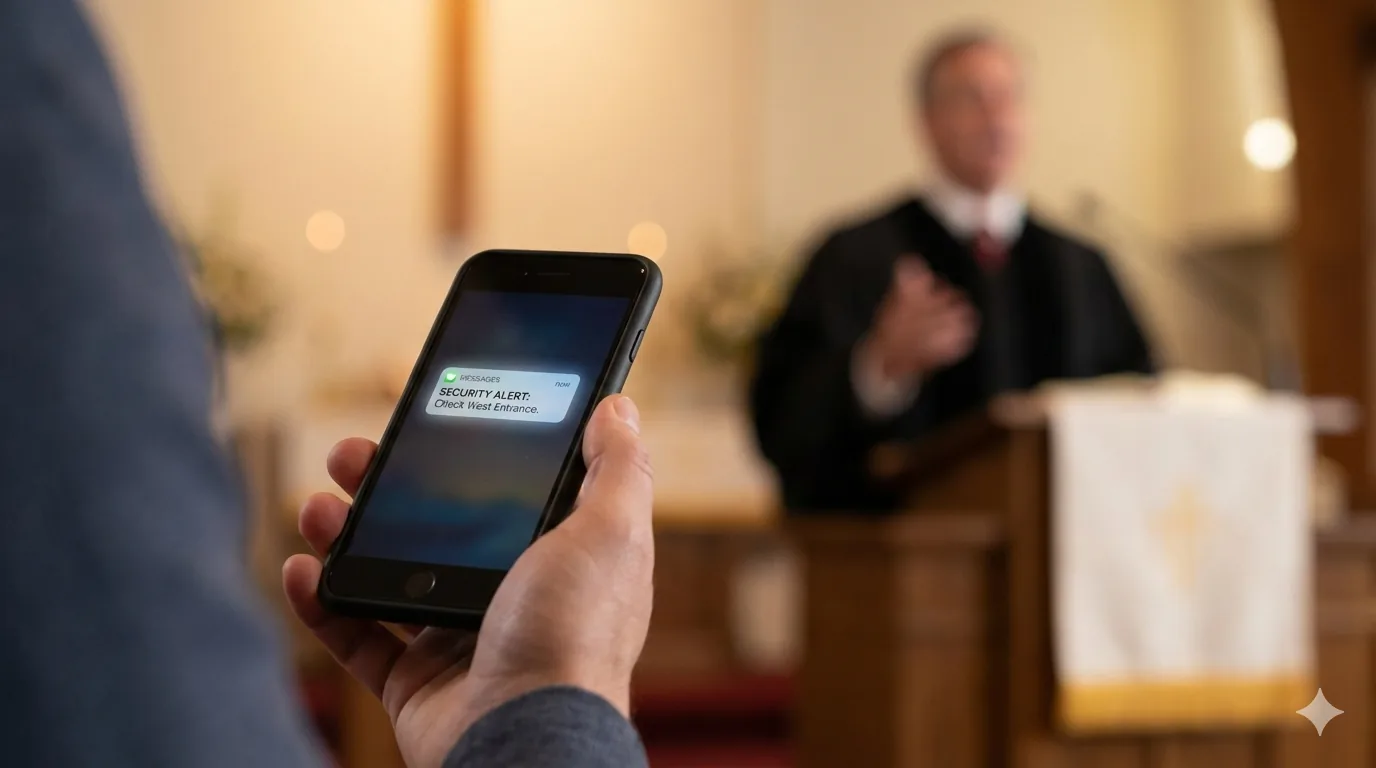
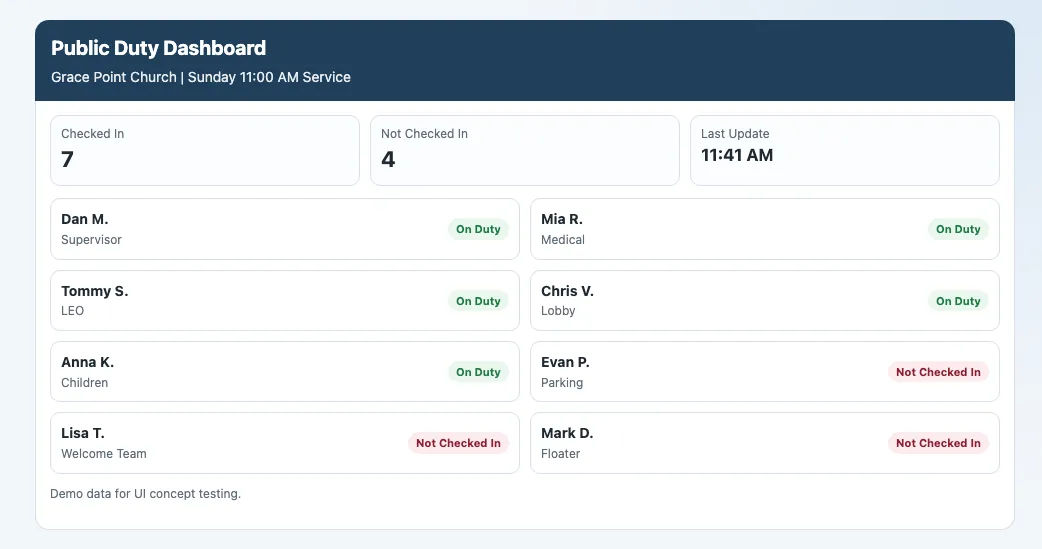
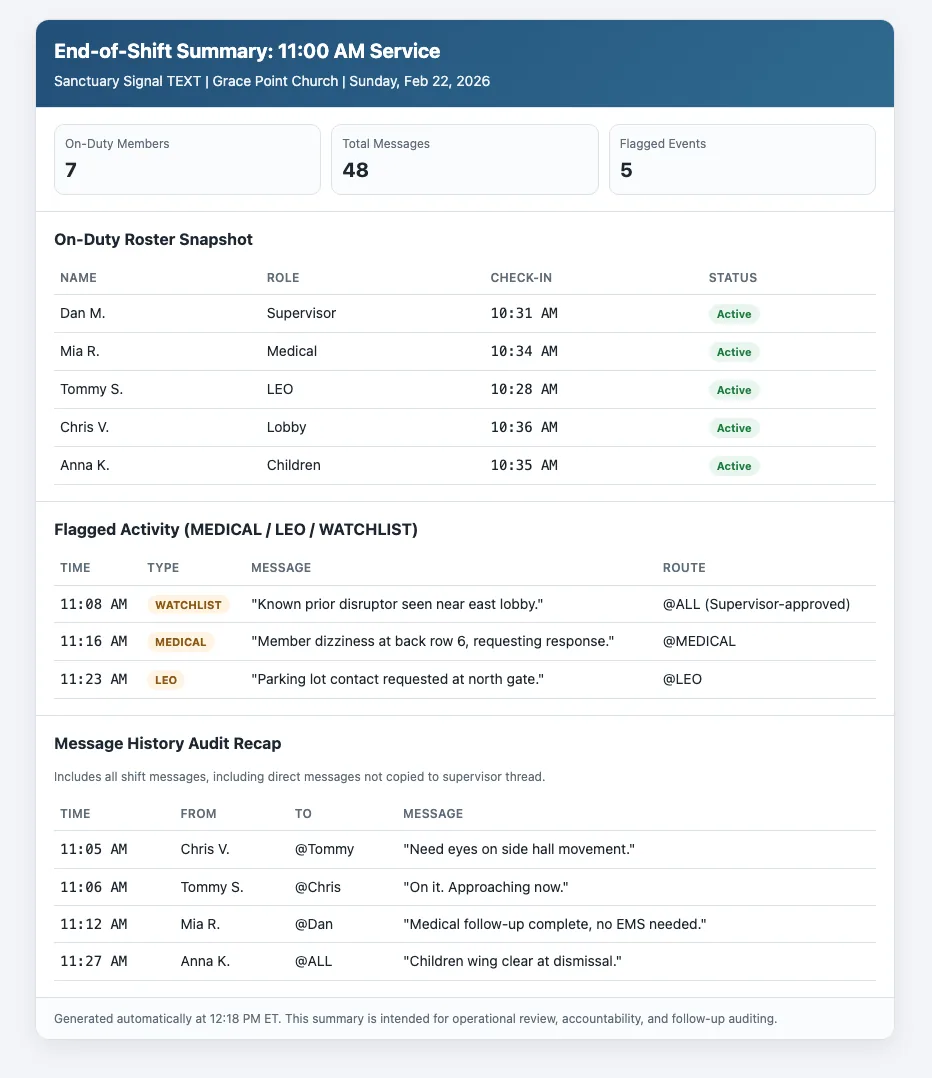
Many campuses keep radios for perimeter voice and add text messaging where quiet and routing matter. We help you say who uses what, when, without a turf war between tools.
Read radios vs texting · Radios, PoC/LTE, and SMS tradeoffs · Helene communication lessons
Church name, contact, and typical monthly team size are enough to start. No pressure to buy on the first call.
Submission Received
Your request was submitted. We will follow up soon.