This page mixes publicly reported recovery facts with lived Western NC experience from the weeks after the storm. It is not anti-radio. It is anti-wishful thinking.
What the public record showed
In late September 2024, FCC Disaster Information Reporting System (DIRS) snapshots for Helene activation counties showed catastrophic wireless outages across Western North Carolina. Reporting windows around Sept. 29 documented large majorities of cell sites offline in hard-hit counties - including Buncombe at roughly four in five sites out in one published snapshot, with mountain counties such as Avery, Mitchell, and Yancey near or above 90% outage in peak windows. Regional rollups put North Carolina sites in the activation area around two-thirds offline at one snapshot.
Newsrooms covering the recovery, including the Charlotte Observer and NBC News, described the same pattern: towers often still stood, but power failures and severed fiber transport left sites unable to carry normal traffic. Verizon and other carriers cited blocked roads, flooding, and fiber damage as the slow factors - not a single broken antenna.
Wired internet tracked the same collapse. Spectrum and other local providers reported related outages. Outside trackers described Asheville-area broadband as severely degraded or near offline for days, with towns such as Waynesville and Hendersonville reported as completely offline in early recovery windows.
Recovery was not "back to normal"
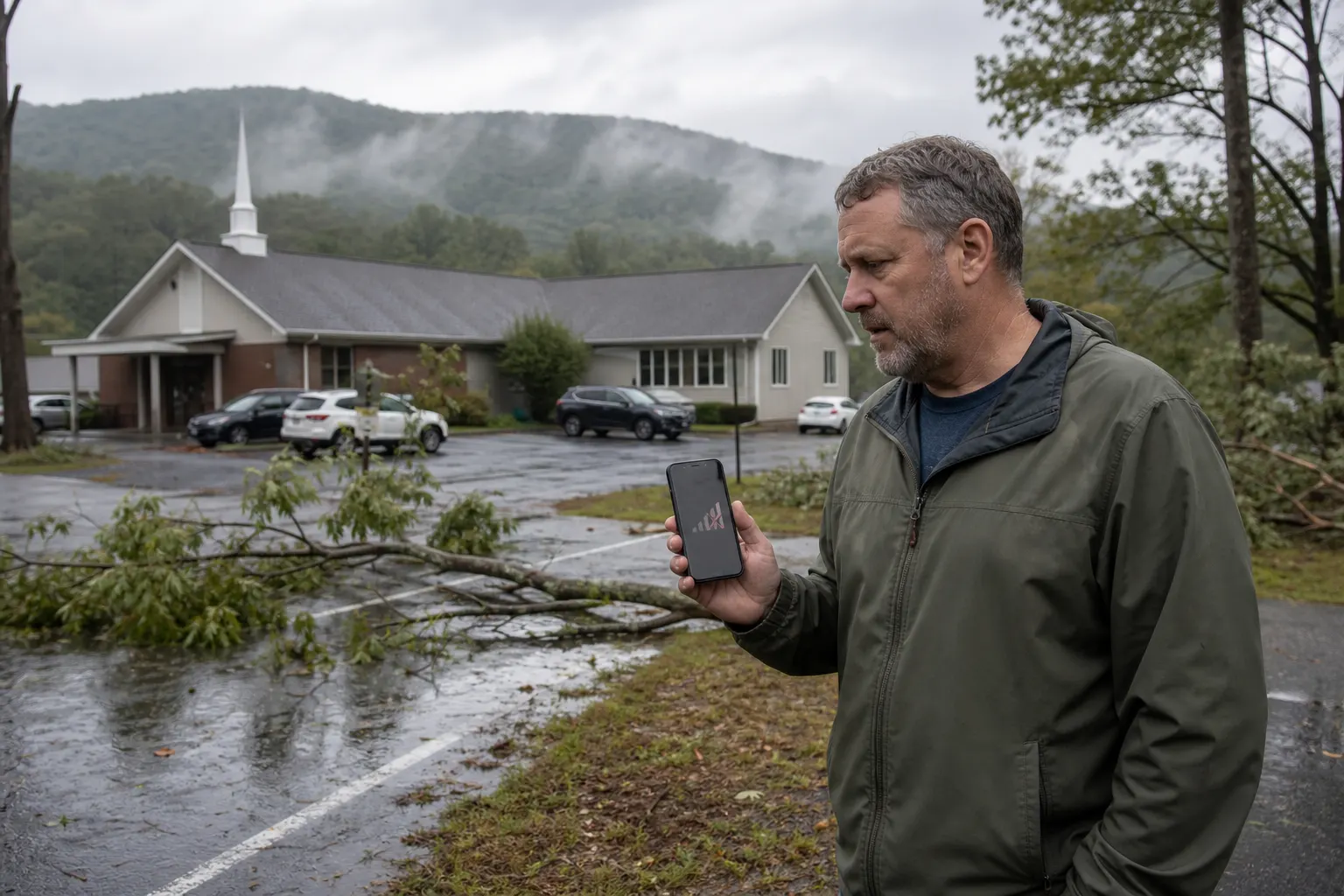
Even after crews reached sites, the user experience lagged. Local reporting captured neighborhoods gathering in parking lots that still had a usable signal pocket while nearby streets stayed dark. Carriers restored sites gradually with generators, temporary transport, and portable assets - including aerial coverage experiments - but residents still described spotty voice and data for well beyond the first 48 hours.
That matches a common Western NC experience: one or more Verizon sites in a given area stayed down for several days, and once towers began coming back, calls and data remained constrained for additional days. The network could look "up" on a map while feeling barely usable for real work.
Disaster roaming, 911 access, and what people actually got
After Helene, North Carolina Emergency Management and major carriers announced temporary disaster roaming so phones could attach to nearby available networks while cleanup continued. That is different from everyday carrier lock-in, and it did help some people reconnect.
Separately, U.S. wireless rules already push devices toward emergency calling on any available site - the familiar "Emergency calls only" / SOS state. In the field, that distinction mattered. Temporary policy changes and emergency-call behavior are not the same as unrestricted roaming for everyday calls, texts, and data. Many people experienced the narrower reality: limited or no commercial traffic even when emergency pathways were being discussed publicly.
Personal field experience during the roughly three weeks after Helene included spinning up two different eSIM providers so there were options when the primary carrier failed outdoors. Carrier redundancy helped at the margins. It did not create a clean, always-on experience.
Starlink and satellite SOS were rare lifelines - not fast ones
Where terrestrial networks stayed dark, people leaned on Starlink hotspots or iPhone SOS / satellite messaging. Those paths could get a message out when nothing else worked. They were also abysmally slow and needed a clear view of the sky. That is a survival option, not a church-campus security workflow.
Indoor sanctuary coverage is already a warning light
Separate from Helene: many church sanctuaries already have weak to very poor cellular signal on a normal Sunday. Thick walls, steel, and seating bowls kill coverage. If your team cannot rely on PoC/LTE radios for routine indoor coordination today, do not invent confidence that the same devices will save you when the region is congested or offline.
Walk-test your building with the phones and carriers your volunteers actually use. Document dead zones. Plan channels around that map - not around a social-media demo filmed outdoors with five bars.
What this means for PoC / LTE radios
PoClink-style and other PoC/LTE devices sell hard on wide-area cellular talk plus UHF/VHF failover. Helene reinforces the limits of that pitch:
- The primary path rides cellular infrastructure that can lose power and fiber transport for days.
- When towers partially recover, voice and data can stay congested and unreliable.
- RF failover can help nearby responders, but GMRS/FRS-style or unencrypted analog fallback is not a private security channel.
- If indoor cellular is already weak in your sanctuary, PoC is a poor primary security backbone.
For the product-level comparison of traditional radios, PoC/LTE devices, and structured SMS, read church radios vs PoC/LTE vs SMS.
The stack we want under stress
Sanctuary Signal TEXT should augment radios, not replace them. In an emergency, the preferred Western NC lesson is:
- Secure UHF voice for urgent, clear coordination - more than consumer GMRS/FRS. Prefer business-band / licensed UHF gear with at least color-code privacy (Motorola-style digital privacy as a baseline), trained operators, and short traffic.
- Structured SMS via Sanctuary Signal TEXT for quiet duty state, routed updates, and best-effort delivery when coverage is thin or when Wi-Fi calling / Wi-Fi paths are available.
- Hop to radio when the text is not moving. If a message is urgent and SMS is not coming or going, key the radio. Disruption matters less than communicating clearly.
Why SMS still belongs in the plan
SMS is best-effort. It is not magic. It does have practical advantages next to continuous data apps and PoC-over-cellular voice:
- Small payloads that often complete when a sustained voice or chat session will not
- Visible send / fail / retry states on modern phones
- Ability to ride Wi-Fi calling or Wi-Fi-assisted paths when configured, instead of depending only on a weak outdoor tower
- Quiet in-sanctuary posture so worship is not interrupted by open-mic traffic for every update
Structured routing is what makes those small messages useful: who is on duty, who may broadcast, and who needs the update. That is the Sanctuary Signal TEXT job - calm accountability on ordinary Sundays and a resilient complement when the region is stressed.
Practical checklist for church leaders
- Walk-test sanctuary, children's areas, parking, and basements on the carriers volunteers actually carry
- Do not buy a PoC fleet as your only continuity story because an ad showed rural coverage
- Keep encrypted / privacy-enabled UHF radio discipline for urgent voice
- Adopt structured SMS for duty state and quiet routing
- Train the rule: if the text is stuck and the need is urgent, use the radio without apology
- Consider multi-carrier options (including eSIM) for key leaders who travel between dead zones during recovery
Frequently asked questions
What happened to cell service in Western North Carolina after Hurricane Helene?
FCC DIRS snapshots and regional reporting documented widespread cell-site outages driven by power loss and damaged fiber transport. Some counties saw the large majority of sites offline at peak windows, and recovery stretched for days with limited usability even after sites began returning.
Did disaster roaming restore normal calls and data after Helene?
Temporary disaster roaming was announced to help phones attach to available networks. Lived experience often still meant constrained commercial traffic. Emergency-call behavior and full everyday service are not identical.
Should church security teams rely on PoC or LTE radios during disasters?
Not as a primary indoor security channel if your building already has poor cellular coverage. Prefer encrypted UHF for urgent voice and structured SMS as a quiet complement, then escalate to radio when a text will not move.
See how Sanctuary Signal TEXT fits beside radios
We help churches map quiet SMS workflows alongside real RF discipline - including the hard-won lessons from regional disasters.
Related resources
- Church radios vs PoC/LTE radios vs SMS
- Radios vs text messaging for church security teams
- A redundant communication layer for safety teams
- Radios vs Sanctuary Signal
- Church security resources
Public reporting referenced above includes FCC DIRS Helene communications status snapshots, Charlotte Observer and NBC News recovery coverage, and WCNC VERIFY reporting on temporary disaster roaming announcements in Western NC.